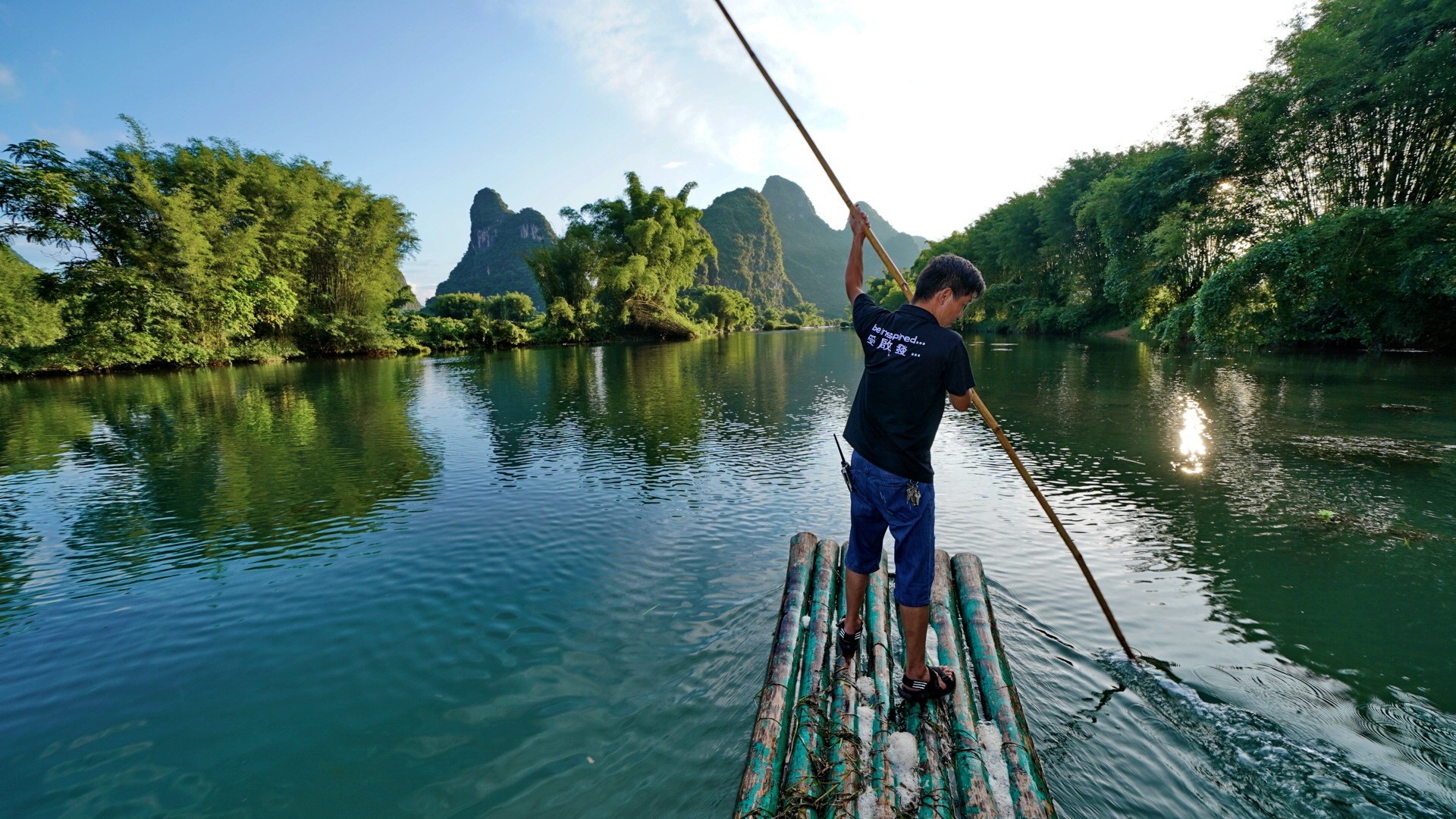
If you’re staying at Yangshuo Mountain Retreat, you’re literally on the river that defines the Yangshuo experience.
The Yulong River runs right in front of our hotel, and bamboo rafting is the activity most guests ask about. After 15 years of working for a riverside hotel and watching thousands of guests float past our terrace, I can tell you exactly what bamboo rafting is actually like in 2026—stripped of the romantic marketing, regulations included, but still absolutely worth doing.
My Rating: 8.5 out of 10 for short trips. It’s a must-do Yangshuo activity if you pick the right route and manage your expectations.
What Is Yulong River Bamboo Rafting?
Traditional bamboo rafts—actual bamboo poles lashed together, not fiberglass replicas—poled downriver by local raftsmen, some who’ve been doing this their entire adult lives. You sit on a plastic chair (maximum 2 people per raft), drift through karst mountain scenery, glide over shallow weirs (fun drops of about one meter where the raft slides down), and experience the Yulong River valley the way locals have traveled it for centuries.
Unlike the busy Li River with its motorized tour boats and cruise ships, the Yulong River has no engine traffic. It’s shallow (5 meters maximum depth), narrow (average 25 meters across), and moves at a gentle pace. The only sounds are bamboo poles clacking against the raft, water moving over rocks, and—in high season—at least one Chinese man on a nearby raft singing patriotic songs.
The Yulong River starts in northern Yangshuo County near Litang and runs over 35 kilometers through small villages including Putao, Litang, Chaolong, Yima, and Gaotian Town before emptying into the Li River around Pingle. Yangshuo Mountain Retreat sits right on this river in the scenic middle section, which is why rafting is so accessible for our guests.
What’s Changed in 2026
Chinese tourism regulations have… evolved. What used to be a freewheeling river experience now comes with more rules.
Current restrictions:
- No swimming in the river (regulations changed—it’s now prohibited, though after 5pm Yangshuo Mountain Retreat guests can swim secretly from our bank unsupervised)
- No bicycles on rafts (don’t ride your bike to the dock expecting to load it)
- Passport required at the dock to purchase tickets
- Booking in advance is no longer required but recommended to guarantee a ticket
- No more long 2-3 hour routes
- Rafts won’t stop at Yangshuo Mountain Retreat embankment anymore (they used to)
The romance of spontaneously hopping on a bamboo raft and drifting wherever the river takes you? More challenging now. But the core experience—floating through stunning karst scenery on actual bamboo with skilled raftsmen—that’s still here, and it’s still worth it.
Current Routes & Pricing (2026)
All routes accommodate maximum 2 people per raft. Here are your actual options:
RECOMMENDED: Jima Wharf → Gongnong Bridge (terminus)
- Price: ¥320 per raft (not per person)
- Distance: 6 km
- Duration: ~80 minutes
- Weirs: 9 crossings
- Why it’s best: This is the sweet spot. Beautiful middle-river section, passes near Yangshuo Mountain Retreat, perfect length—long enough to feel immersive, short enough that you’re not bored or uncomfortable. From Gongnong Bridge, it’s only a 20-minute walk back to Mountain Retreat on a quiet back road. This is what I recommend to most guests.
FOR TIME-LIMITED GUESTS: Shuiedi Dock → Gongnong Bridge
- Price: ¥200 per raft
- Distance: 3 km
- Duration: ~40 minutes
- Weirs: 4 crossings
- Why it works: Shuiedi Dock is only 1.5 km upriver from Yangshuo Mountain Retreat—ridiculously convenient. If you only have a couple hours or want a taste of bamboo rafting without committing to the full experience, this is your route. The official chart calls it “least popular,” but that’s actually a selling point—fewer crowds, quick experience, easy logistics.
LONGEST OPTION: Jinlong Bridge Wharf → Jiuxian
- Price: ¥320 per raft
- Distance: 6 km
- Duration: ~90 minutes
- Weirs: 9 crossings
- Description: Upper Yulong River section. The chart describes it as “most thrilling” with wide water and mountain scenery. Furthest from Mountain Retreat, so you’ll need transport both directions.
SCENIC UPPER SECTION: Xiatang Dock → Jima Wharf
- Price: ¥200 per raft
- Distance: 3 km
- Duration: ~45 minutes
- Weirs: 4 crossings
- Description: The official chart calls this the “most scenic” route. Upper/middle river section with impressive karst views.
Our Honest Take: Short Trips vs. Long Trips
Short trips (40-90 minutes): 8.5/10 — Absolutely worth it. You get the full experience without the downsides.
Long trips (2+ hours): Skip them — And good news: the government already eliminated these routes, so you can’t make this mistake anymore. Here’s why longer isn’t better:
Bamboo rafting is beautiful and meditative for the first hour. After that? You’re sitting on a plastic chair getting incrementally wetter, the scenery becomes repetitive, and if weather turns bad, you’re stuck on a river with no exit strategy. Two hours of wet clothes in changing weather isn’t romantic—it’s miserable.
The short routes give you everything: karst mountain views, the experience of floating on bamboo, gliding over weirs, watching village life along the riverbanks, and the satisfaction of saying you did it. Then you’re done before you get bored, cold, or uncomfortably wet.
Practical Tips from Our 25 Years on The Yulong River
Timing Matters
Morning is always better than afternoon. Here’s why:
- Cooler temperatures (especially May-September)
- Less chance of heavy rain developing
- Better light for photos
- Fewer crowds (marginally)
- River is calmer before afternoon winds pick up
Avoid winter (December-February). Yes, rafting operates year-round, but you’re going to get wet on the raft—not soaked, but splashed. Sitting in damp clothes for 80 minutes when it’s 8°C outside is the opposite of fun. Spring (April-May) and autumn (September-October) are ideal. Summer works but prepare for heat and occasional afternoon storms.
You Will Get Wet
Not drenched. Not swimming-level wet. But splashed. The weirs’ (small 1-meter drops where the raft slides down) send water onto the raft. Your raftsman might splash you playfully. River spray happens.
Bring a waterproof pouch that goes around your neck for your phone and wallet. Get a proper waterproof pouch with a lanyard—available at any shop in Yangshuo town or we sell them at Mountain Retreat reception.
Wear shoes that can get wet. Flip-flops work but can fall off at weirs. Water shoes or old sneakers are better. Don’t wear your nice hiking boots or leather sandals.
The Passport Requirement
Yes, you need your actual passport at the dock to purchase tickets. A photo on your phone won’t work. This is 2026 China—security has reached impressive levels. Don’t forget it, or you’ve wasted a trip, and keep it in your plastic pouch with your phone.
Book Through Mountain Retreat
It’s no longer advised to just show up at the dock anymore. We recommend you reserve in advance. Our front desk handles all bookings—we’ll arrange your raft, confirm pricing, and tell you exact pickup times. We don’t charge any commission. We know which routes are running, current weather conditions, and whether the river is safe (flash flooding can make it dangerous fast).
The Flotilla Experience
In high season and Golden Weeks (First week of May, first week of October, Chinese New Year), you’re not floating alone in serene nature. You’re part of a convoy of 20-50 bamboo rafts moving downriver together like a bamboo armada. There will be Chinese tourists. There will be singing. There will likely be at least one enthusiastic gentleman belting out patriotic songs at impressive volume.
This is not necessarily bad—it’s just reality. If you’re expecting a private, silent communion with nature, adjust your expectations. If you can embrace the chaos, it’s actually kind of fun in a uniquely Chinese way.
Common Tourist Mistakes
Don’t bring your bicycle to the dock. They won’t let you load it on the raft. This regulation is new as of recent years and can catch people by surprise. If you cycle to the dock, you’re cycling back too.
Don’t expect rafts to stop wherever you want. The routes are fixed. Rafts won’t pull over for photo ops at specific spots, and they definitely won’t stop at Yangshuo Mountain Retreat anymore (they used to, which was wonderful, but regulations killed that).
Don’t overdress. It’s a hot, humid environment even in spring/autumn. Light, quick-dry clothing works best. That heavy cotton t-shirt will stay damp and uncomfortable. A light rain jacket is always recommended.
Don’t skip breakfast. There are no food vendors mid-river. You’re on that raft until you reach the endpoint. Eat before you go. Also, bring some water, or some already chilled adult beverages.
What About Swimming?
Swimming in the Yulong River used to be one of Yangshuo’s simple pleasures—clear pools, gentle currents, karst mountains overhead. That’s now prohibited. Regulations changed. You’ll see “No Swimming” signs.
The river is still clean enough (despite some brownish foam in eddies from agricultural runoff), but officially, swimming is not allowed. Do with that information what you will, but don’t expect us to recommend it or provide support if you get in trouble.
The Yangshuo Mountain Retreat Advantage
Location: We’re directly on the Yulong River. Shuiedi Dock is 1.5 km away. Gongnong Bridge (endpoint for both main routes) is a 20-minute walk. You’re not taking hour-long taxi rides to distant docks—you’re literally steps from the river.
Booking support: Our staff handles all reservations, knows current pricing, understands which routes suit different fitness levels and time constraints, and will tell you honestly if weather looks bad.
Post-rafting: After floating downriver and walking back to Mountain Retreat, our riverside restaurant and bar are open. Cold drinks, hot coffee, full menu, comfortable seating, and you can sit on our terrace watching other rafts drift by while you dry off.
Local knowledge: We’ve been here since 2001. We know this river in every season, every water level, every weather condition. If we say conditions aren’t good for rafting that day, believe us.
Alternatives and Combinations
Can you combine rafting with cycling? Not on the same raft (bicycles not allowed), but you can absolutely cycle to upstream docks, raft down, then walk back to retrieve your bike later or have someone from the hotel pick it up. Ask our front desk about logistics.
What about walking along the river instead? The riverside footpath from Gongnong Bridge to Mountain Retreat is beautiful. If rafting doesn’t appeal or weather is bad, walking gives you the same scenery at your own pace. The 13km route from Gongnong Bridge past Chaoyang Village and Jiuxian Village to Yulong Bridge is one of Yangshuo’s best walks.
Other activities from Mountain Retreat: Check out our complete guide to Yangshuo outdoor adventures including hiking, rock climbing, caving, and cycling routes. Also see our things to do in Yangshuo blog post for comprehensive activity recommendations.
Final Verdict
Bamboo rafting on the Yulong River deserves its 8.5 out of 10 rating. It’s one of those activities that actually lives up to the hype—if you pick the right route, go at the right time, and manage expectations around regulations.
The Jima Dock to Gongnong Bridge route (80 minutes, ¥320) is what I recommend to most guests. It’s long enough to feel complete, short enough to stay enjoyable, and logistics are easy from Yangshuo Mountain Retreat.
If you’re short on time, the Shuiniwo to Gongnong route (40 minutes, ¥200) gives you a solid taste without the commitment.
Avoid winter, go in the morning, bring waterproof protection for your phone, and don’t forget your passport. Accept that you’ll be part of a flotilla in high season and that some Chinese gentleman will probably serenade you with patriotic songs.
It’s not the wild, unrestricted river experience it was 20 years ago—welcome to 2026 China, where even bamboo rafting requires advance booking and passport checks. But the core magic is still there: floating on actual bamboo through one of the world’s most stunning karst landscapes. That’s worth experiencing at least once.
Book your bamboo rafting adventure at Yangshuo Mountain Retreat’s front desk, and we’ll handle everything else.
Frequently Asked Questions
How much does Yulong River bamboo rafting cost?
Prices range from ¥200-320 per raft (not per person) depending on route. The most popular Jima Pier to Gongnong Bridge route costs ¥320 for 80 minutes covering 6km. The shorter Shuiniwo to Gongnong route costs ¥200 for 40 minutes covering 3km. Maximum 2 people per raft. Book through Yangshuo Mountain Retreat front desk for current pricing and reservations.
What’s the best time of day for bamboo rafting?
Morning is always better than afternoon. Cooler temperatures (especially May-September), less chance of heavy rain, better photo light, and calmer river conditions before afternoon winds. Avoid winter months (December-February) completely—you’ll get wet on the raft and sitting in damp clothes when it’s cold is miserable.
Do I need to bring anything for bamboo rafting?
Essential: waterproof pouch with neck strap for phone and wallet (ziplock bags fail), your passport (required at pier for tickets), water shoes or old sneakers (flip-flops can fall off), light quick-dry clothing, sunscreen, and hat. Optional: small water bottle, snacks (no food vendors mid-river). Don’t bring: bicycles (not allowed on rafts), valuables, cotton clothing that stays wet.
How long does Yulong River bamboo rafting take?
Route duration varies: Jima to Gongnong takes 80 minutes (6km), Shuiniwo to Gongnong takes 40 minutes (3km), Jinlong to Jiuxian takes 90 minutes (6km), and Xiatang to Jima takes 45 minutes (3km). Add transport time to/from piers. From Yangshuo Mountain Retreat, expect 2.5-3 hours total for the Jima route including the 20-minute walk back from Gongnong Bridge.
Can I swim in the Yulong River?
No. Swimming in the Yulong River is now prohibited by government regulations as of recent years. You’ll see “No Swimming” signs along the river. This is a change from previous years when swimming was one of Yangshuo’s simple pleasures in clear river pools.
Which bamboo rafting route is best from Yangshuo Mountain Retreat?
Jima Pier to Gongnong Bridge (¥320, 80 minutes) is the sweet spot—beautiful middle-river section, perfect length, only 20-minute walk back to the hotel. For time-limited guests, Shuiniwo to Gongnong (¥200, 40 minutes) works well since Shuiniwo Pier is only 1.5km from Mountain Retreat. Both routes end at Gongnong Bridge within easy walking distance of the hotel.
Will I get wet during bamboo rafting?
Yes, you will get wet—not soaked, but splashed. The weirs (small 1-meter drops where rafts slide down) send water onto the raft. River spray happens. Your raftsman might playfully splash you. This is why morning trips and avoiding winter months is crucial—sitting in damp clothes for 80 minutes when it’s cold is the opposite of fun.
Can I bring my bicycle on the bamboo raft?
No. Bicycles are not allowed on bamboo rafts as of current 2026 regulations. Don’t ride your bike to the pier expecting to load it onto the raft. If you cycle to the starting pier, you’ll need to arrange to retrieve your bike later or cycle back to get it after rafting.
How do I book bamboo rafting from Yangshuo Mountain Retreat?
Book through Yangshuo Mountain Retreat’s front desk—you cannot just show up at piers anymore. Our staff handles all reservations, confirms current pricing, knows which routes are running, and can advise on weather conditions. You must bring your passport to the pier to purchase tickets. We can arrange transport to upstream piers and provide detailed directions for walking back from Gongnong Bridge.